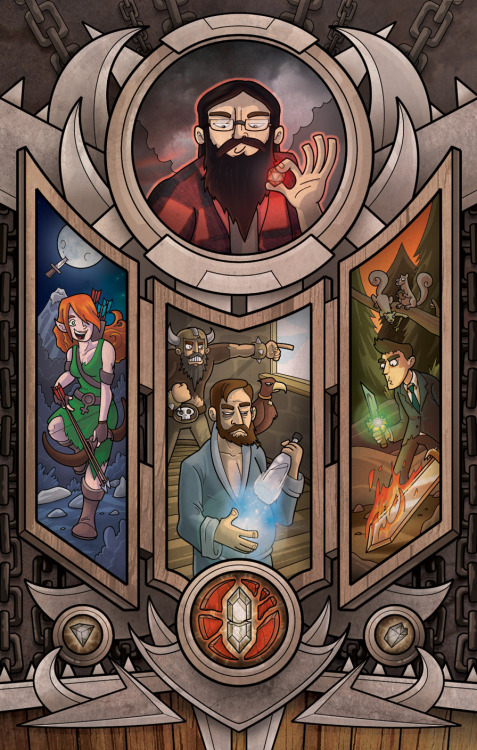
Don’t cry for Dan Harmon. Yes, he’s still the most famously unemployed writer in television. Yes, two people who are not Dan Harmon are now running Community, the cult sitcom Harmon created in 2009 and was fired from by NBC three years later.1 But things are looking up. A few days ago, Harmon handed in a pilot script to CBS. Today they called and said they liked it, that everybody liked it, all the way up the chain to Les Moonves, the president of the network. There’s a certain Famous Comedic Actor on whose participation the show’s future kind of depends, but that’s between the network and the Famous Comedic Actor’s agents. And there’s still the small matter of the other pilot script Harmon’s supposed to be writing, the one he owes to Fox, the one he jokes about not having written a word of, the one of which he maybe really hasn’t written a word yet — but that’ll happen when it happens.
Right now it’s dusk in Portland, Oregon. Harmon’s had a couple of afternoon drinks, and now his old friend Robby is driving Harmon, Harmon’s girlfriend Erin McGathy, a documentary filmmaker named Neil Berkeley, and me across the Willamette River in a Mercedes, to a comedy club above a bike store, where Harmon and his partner Jeff Davis will get onstage and record a live podcast called Harmontown in front of a sold-out crowd that has paid money to watch Harmon drink more drinks and say whatever comes into his head.
Harmon tells Neil the news about the pilot, and there’s some talk about whether Sumner Redstone is Les Moonves’s boss or it’s the other way around, and about what an excellently wizardy-sounding name “Sumner Redstone” is, and then Berkeley says, referring to the pilot, “So, what happens next?”
“Well,” Harmon says, like a seasoned television veteran about to drop some hard-won knowledge, “now Les Moonves has to go to the Temple of Mumm-Ra and turn into Sumner Redstone — they’re both mummies, but one’s bigger than the other — and fight Lion-O. Then I have to use the Sword of Omens to get Sight Beyond Sight. And if I’m approved by Panthro, I will go to green-light on Endor. Which — a lot of people don’t know this — is just a moon. Just a moon. Feels like a planet.
“This is how TV works,” he says. “It’s all run by a giant diamond robot named Sal Whitwind, who was once human but who encased himself in diamonds so that he’d survive in space … ”
“His cheeks are always red, but ice-cold,” Erin says.
” … and he has a giant umbilical cable going from his crotch to the stratosphere, which depletes the ozone but provides entertainment,” Harmon says. “And once he’s done filling the Earth with television, he will start to fuck Jupiter with his giant robot dick. Terraforming, they call it — brought to you by Snickers! What was the real question? You wanted to know what happens? You get a production order for a pilot, and then the pilot either gets picked up or not. A series order. Could be six, could be nine, could be 13 — all that stuff still confuses me. Then you eat the fat of an unbaptized baby.”
Like I said — he’s had a couple of drinks. He and Erin keep kicking the joke back and forth, making each other laugh. The sun is going down; the network-television development process seems far away and abstract, something for giant insane diamond-skinned robots to worry about. Harmon is in a state of grace. On January 3, he turned 40 years old; one week later he and Davis and McGathy and a small group of co-conspirators boarded a bus and set out on a 20-city tour. Harmoncountry, as it’s been hashtagged, is a three-week birthday party for Harmon — a Viking funeral for his youth, after which McGathy will move into his house in Los Feliz and they will begin the process of getting a puppy. It’s a chance for him to get out there and meet his fans, and accept their hugs and their fan art and their homemade baklava, and sign whatever they put in front of him, and repay some of the love-hours they’ve put into his work over the years. And it’s an excuse for him to put off writing — a process he’s compared to being locked in a prison cell with God and letting Him have His way with you — and sail across this great nation on a river of Ketel One. Not necessarily in that order.
♦♦♦
These days the people who make television are expected, for a variety of promotional and fan base–stroking reasons, to engage in something resembling dialogue with their viewers. But Harmon was the first showrunner who seemed like he was creating a TV show in order to have that dialogue. Community was Harmon shooting off a flare gun to attract like-minded weirdos, articulating a worldview — institutions are bad, individuals are good, normalcy is an illusion, people who feel uncomfortable on the planet constitute a kind of sociocultural 99 percent, what we all have in common is our brokenness. Every character represented a facet of his personality; every episode was packed with callbacks and homages and fractalized sub-references aimed at people who, like him, had been warped and saved by pop culture at an early age. And he wanted us to know he was doing this. He didn’t just want the attention that came from blogging, tweeting, Reddit-ing, and annotating every episode for the A.V. Club — he seemed to need it, for reasons deeper than ego or vanity. He wanted to be out there in direct communication with the small but passionate group of people who liked his TV show because he wanted to connect.
“Other people consider it, like, a weird flood that you have to put a gate up to control; for me, it’s like there’s a drought,” Harmon says. “There’s still not enough understanding between me and other people. I don’t know if there ever will be, so the more I can get, the better. I’m bad on the phone; I’m bad at therapy; I’m bad at one-on-one; I’m bad at playing board games; I’m bad at hanging out. But I’m OK at talking to people in a big group. The permission to keep rambling without having to apologize. When I put the thoughts that rattle around in my brain into a microphone and hear a bunch of other people hear them and either not react to them or laugh at them, something happens to me that makes me feel like I might live another day without an ulcer or a tumor or something. Like, I feel like I’m getting something done emotionally.”
When he started doing Harmontown with Davis in 2011, it was an extension of that same impulse. The conceit, at first, was that the show was a town hall meeting, at which Harmon and the audience would discuss how to build a new and improved society, possibly as a secessionist lunar colony. Harmon was the mayor of Harmontown; Davis — an actor and improv comic who was a regular on the U.S. version of Whose Line Is It Anyway? — served as “comptroller,” which in the context of Harmontown meant he sat behind a podium at stage left and did the work of an announcer, interlocutor, musical director, and traffic cop, depending on what the moment required. Davis always wore a suit and tie; Harmon dressed like the TV writer he was, usually in jeans and something plaid and wrinkled. He’d show up without a plan, drink Ketel on the rocks out of a red Solo cup, and say and do whatever he could think of to provide the audience with $10 worth of entertainment. Davis was in charge of flow, judging when to bail Harmon out of a spiraling tangent or let him dangle for the audience’s amusement.2
Harmon was still doing Community back then, and sometimes he’d take questions about the show — and speak candidly about the frustrations of producing a low-rated network sitcom. “When I’d feel like a fraud, or like I didn’t do a good job on this or that episode, I would talk frankly about it,” he says. “And I would say to the audience: ‘Please don’t record this and YouTube it. Let’s have a social contract where, because you won’t do that, I’ll continue to feel free to talk about this stuff.'”
And what happened at Harmontown stayed at Harmontown, until early 2012, when Harmon played the crowd some angry voice mails from a seemingly inebriated Chevy Chase — they were feuding, and Harmon had insulted him in public at a Community wrap party. Someone posted audio from the show in a Harmontown thread on Reddit; the story jumped from there to Deadline Hollywood to TMZ.
Within a few weeks, NBC had fired Harmon as showrunner of Community. It wasn’t because of the Chase thing — “They were like, ‘Who gives a shit?’ about that,” Harmon says. Under Harmon’s stewardship, the show was consistently over schedule and over budget and didn’t pull the kind of ratings that would have made those issues ignorable; Harmon doesn’t dispute this. (Hang out with Harmon long enough and eventually he’ll talk about why he was fired, ping-ponging between self-deprecation and self-aggrandizement within the space of a sentence; you’ve heard most of it before.) With the leak of the Chase thing, Harmon says, “the perimeter had been breached”; plus he no longer had a job to protect. They began posting each Harmontown show online in July.
“There is nothing interesting left for me to say,” Harmon announces near the beginning of the first episode. “I am Ace Rothstein in late Act II of Casino: ‘And another thing, Mr. Governor … !’ I’m third-act Lenny Bruce.”
This was a rare example of false modesty on Harmon’s part. He always has something to say. You could tell that being fired, and being at the center of a minor media circus as a result of having been fired, was unpleasant and weird for a guy like Harmon, that it was a little like Charlie Kaufman entering a Malkovich portal and becoming Charlie Sheen — but it was clear there had been something magical and transformative about it, too. On that first podcast, he spoke of “achieving weightlessness.” He was Sheen, a little bit, but at certain moments he was also the disc jockey Dick “Pepsodent” Gibson in Stanley Elkin’s novel The Dick Gibson Show, dismissed from a strange radio gig in Nebraska, drifting home by bus, lost and elated. “There’s a certain kind of disgrace,” Gibson says, “in declining fortunes.”
If you listen back to the last year or so of Harmontown podcasts, one of the things you’ll hear is a fired TV writer taking refuge in the arms of his superfans, retreating to the nerd-cave to go on breakneck conversational tears about Joseph Campbell and RoboCop and race and writing and evolution for a self-selecting audience that can’t get enough of his hyperarticulate bullshitting. The fact that this show was born in the back of a comic-book shop is symbolically crucial; Harmontown is a geek utopia, a Dreamatorium, a place where a Neil Gaiman joke gets a laugh and a sub-reference to Ford Prefect within that joke gets a bigger laugh.
It’s a place where people will pay to watch Harmon, Davis, McGathy, and the occasional almost-celebrity guest (Greg Proops!) play Dungeons & Dragons onstage, as they do at every show, with help from a Dungeon Master named Spencer Crittenden, a burly, bearded, Sphinx-ishly deadpan 23-year-old who resembles a River’s Edge extra but actually works in the stockroom of an Apple Store in Simi Valley. One night Harmon — who was heavy into D&D when he was a kid3 — asked if there were any DMs in the crowd who could help set up a campaign; Crittenden raised his hand. Since then, he’s been a part of every show; he’s become a cult figure4 and the subject of lovingly detailed fan art; Harmontown is the kind of place where of course a guy like Spencer becomes an instant star.
But it’s also a place where Harmon can be honest. About everything. Dig into the archives and you’ll learn about how frequently Harmon poops his pants (more than you’d expect), and about his panic attacks, and his fetishes (red hair and nylons, first and foremost). You’ll learn that he’s hopelessly devoted to the people who are hopelessly devoted to his work — that he reads comment threads, peruses the fan Tumblrs where his quotes and blog posts and Instagram pictures are clearinghoused,5 and sees no point in lying about it.

You’ll also learn that Dan smokes weed — it’s L.A., he has a prescription — and that much of the second season of Community was brought to you by Adderall, and that he does cocaine on occasion, when it’s around, usually to stay awake and keep drinking, even though he feels it’s a “grody, Don Johnson–y” drug to take. You’ll learn what he and McGathy fight about, and occasionally you’ll hear them fight. No subject is too small — in the weeks leading up to the tour, Harmon started doing a regular feature called “Things Dan’s Afraid to Complain About Because It’ll Make Me Sound Like an Asshole” (example: Dan and his decorator both agree that Dan’s gardener is doing a bad job).
It’s not stand-up, it’s not theater, and it’s not a lecture, although sometimes it feels like all those things. (Maybe not theater.) It’s filed under “comedy” in iTunes, which isn’t wrong, but its best moments belong in some imaginary genre alongside books like Ben Lerner’s Leaving the Atocha Station and Sheila Heti’s How Should a Person Be?, the parts of Marc Maron’s WTF podcast where you’re listening to Marc Maron talk to himself about Marc Maron, the self-deconstructive nonfiction of David Shields’s last few books, maybe the instantly legendary “cancer set” comedian Tig Notaro recorded at Largo last year, maybe Frank Ocean’s Channel ORANGE — autobiographical work that derives its charge from a compulsion to confess, narrated from an in-the-moment POV by people not particularly concerned with their likability.
So Harmon gets up onstage, confesses to the crime of being Dan Harmon — bad boyfriend, high-functioning alcoholic, approval-hungry self-Googling6 mansion-owning gardener-having man-baby, petty, loathsome human — and somehow the results are cathartic and funny, and the essential truth that we are all shitty people and therefore we are all in this together is affirmed.7 Sometimes it’s like being at a weird college seminar run by a substitute teacher in the middle of a drunken meltdown and sometimes it’s like hanging out in Dan Harmon’s living room. Sometimes people from the audience wander onstage; sometimes when this happens (or when Jeff says something like How’s everybody doing tonight? and Harmon interrupts and tells the crowd that they don’t have to answer that with applause if they don’t want to) it feels like all the basic assumptions and rules of entertainment are up for debate. It’s almost never boring, it’s usually funny, and whenever the energy flags, Jeff Davis will cue up a hip-hop beat on his iPad and Harmon will start freestyle rapping, usually about fucking somebody’s mom, and dancing like a 3-year-old in footie pajamas who’s been allowed to stay up late to put on a show for cocktail-party guests.
“We’ve asked ourselves what the point of Harmontown is,” Jeff Davis says. “Dan’s never really had a good answer for it yet. [But] I really think it’s the idea that self-love and self-hatred are the same thing. Dan hates himself; he also worships himself, and the fact that 90 people will come to every show that we do, and they’ll love him — I think it’s an experiment in finding out whether or not those people are being sincere. ‘Do they really like me, or do they like the idea of me? Am I good person? What if I came out onstage and didn’t do a show? What if I just rapped about fucking your mother? What if I didn’t do anything? What if I took my shirt off, and I’m fat? What if I go off my diet? What if my girlfriend came out and told you I called her a c—?8 Would you still like me?'”
Which is how you get to something like the Sharpie story. It happened late last August. I was in the audience; so, for some reason, was a man Harmon introduced — midway through the conversation I’m about to describe, rendering it that much more bizarre — as Henry Kissinger’s son.
Davis and Harmon had been talking about Harmon’s fetishes, and specifically about a phase of intense solo sexual exploration Harmon went through in the ’90s, in which Harmon attempted to streamline his sex life by figuring out exactly what he was and wasn’t into. Harmon detailed his crush on Cynthia Kereluk, a Canadian aerobics instructor from the ’80s; Davis told a story about driving with Harmon to buy a cardboard box of tights-and-pantyhose fetish-porn videos from a sketchy guy in the parking lot of the El Pollo Loco on Sunset and La Brea. This led to a conversation about a period in which Harmon was into mannequin parts, and then — while they were on the subject, just to get it out of the way — Harmon volunteered that around the same time, he’d purchased a RealDoll.
Everyone knew right away that he wasn’t joking, and nobody laughed. I don’t think I’ve ever heard a room go quiet that fast; it was like we were on a spaceship on which some kind of explosive decompression had occurred. There was a split-second pause that felt like it weighed a thousand pounds. “It costs a lot of money,” he explained, “and they send you a fake woman in a crate.” (He’d just sold a pilot to Fox and was flush with cash.) Jeff joked about how nobody saw Dan for three months after that, and then told a story about trying on a girlfriend’s fishnets, and then Harmon said, “Uh, you know what I did once?”
Then he said that what he was about to say was something he’d never told anybody, except the Community writers’ room, in hopes of fostering a climate of openness and write-what-you-know confessionalism. Suddenly the air was charged: What else could he possibly say? Harmon savored the moment: “Isn’t that a refreshing thing, though?” he said to Davis. “To not know for sure that what I’m about to say isn’t going to make your eyes fall out of your head?”
“I used to fuck a plastic lady, but here’s something I’ve never told anybody,” Davis said.
And then he told the Sharpie story. Harmon read something in Penthouse‘s advice column about prostate stimulation, decided to try it: “I thought, I’m not gonna put my finger in there, because it’s a butt. That’s gross … So it’s foreign-object time.” The story itself isn’t that important. He keistered the Sharpie, he masturbated, he finished, he immediately lost interest in having things in his butt and threw the Sharpie away.9 The point was the tension before the story — the raising of the possibility that what Harmon might say next would be genuinely horrifying, would violate the strictures of entertainment in some irreparable way and ruin everybody’s night.
Where was he going with this? Was it somewhere we’d want to go? Would we regret having come here tonight, would we leave hating Dan Harmon and too weirded-out to watch his stuff anymore? When he told the story and it turned out to be merely gross and absurd — as all envelope-pushing jerking-off stories tend to be — the laughs it got were one long rolling sigh of relief, like we’d just watched Harmon bring a plane down safely on one engine. All of us in that room were together and alive in that moment, and I swear to you that if we’d tried we could have levitated that comic-book store with our minds — although, at some point soon thereafter, I noticed that Henry Kissinger’s son had left the room. He never came back.

Portland, a little earlier: Harmon’s in a bar called Embers, leaning back in his chair, maybe a little too far. They have drag shows here at night, but right now, aside from the empty stage and the Mardi Gras tinsel and the indoor movie-theater marquee that reads ASK ABOUT BACON NIGHT,10 it just looks like a big, empty dive bar — except for the bar itself, which is one long tempered-glass tank full of goldfish, like a cartoon pimp’s heel. We’ve been talking about the only question that seems worth discussing right now, which is the question of why he does Harmontown, and why he’s on this tour.
“It’s therapy,” he says. “Like, my dad made stained glass in the basement. Grandpa made birdfeeders and doghouses and shit, did carpentry. There’s the thing that you do that’s your livelihood to try to fulfill your obligation and stave off your fears of dying and not having money and stuff, so you go and punch a clock, and then there’s that thing that you do, that outlet. So for me, this thing that I do to pay my bills is what other people do as an outlet. I get to sit on my ass and masturbate for most of the day and then write a bunch of jokes or stories about people that never existed. So if that’s my job, if that’s paying my rent, then what is my obligation to myself as a hobby? I don’t want to make a birdhouse, and I don’t care about stained glass.”
It’s a few hours before the Portland show, which is the second-to-last show of the tour; early tomorrow morning, the Harmonbus leaves for San Francisco. Harmon is drinking double Ketels on the rocks. I should probably say here that I spent maybe 20 hours with Harmon over the course of three days, and except when we were in transition from one location to another, there was seldom a point when he wasn’t drinking. But he never seems particularly drunk, except at certain moments during the actual show; the rest of the time, no matter how many he’s had, he continues to speak in paragraph-long bursts of focused, un-slurred, hyper-precise prose. Sometimes he’ll say something like, “… and this is hard to articulate after this many drinks, but,” and then proceed to perfectly articulate what he’s trying to say.
When I ask if it’s OK to turn on my digital recorder, Harmon says “Are you kidding?” pulls a lipstick camera out of his pocket, and affixes it to his ear like a Bluetooth. The Harmontour is sort of a roving media conglomerate; its digital-content footprint is vast. Podcast engineer Dustin Marshall records each show, does a quick edit with Harmon afterward at the hotel or on the bus,11 and puts a new podcast online almost every day. McGathy has recorded a few episodes of her own relationship-themed podcast, This Feels Terrible, on the road; she’s also doing a regular video-diary series, “Daily Feelings,” with Crittenden, who’s taken some time off from his Apple job to join this circus. Everybody’s got a smartphone, everybody’s tweeting and Instagramming and Vine-ing.
Most importantly, Neil Berkeley and his crew are filming everything for a tour documentary that Harmon is financing through his production company, Starburns Industries. There are cameras present before, during, and after every show, backstage, and on the bus; there were cameras rolling when the Harmoncountry crew hit a Dave & Buster’s in Kansas City, and later tonight in Portland Jeff Davis will invade the green-room bathroom and film Dan Harmon taking a preshow dump.
“It’s a little Truman Show–y,” Harmon says. “Like, they’re always there.”
They’ve shot enough footage to make six movies — there’s a Comedians of Comedy–style tour-souvenir film somewhere in there, absolutely, but there’s more than that, and not all of it is funny or pleasant. Things got weird in Pittsburgh; McGathy and Harmon had a fight onstage during D&D. It made for squirmy, riveting listening. McGathy, 28, is a comedian and writer who met Harmon through a friend who wrote for Community; they’ve been dating for a little over a year. She’s a recurring character in the show, and when Jeff has other commitments she fills in as comptroller. Those episodes usually end up being weirdly compelling peeks into the dynamic between Harmon (who is obviously at least a little bit of a crazy person) and McGathy (who’s at least crazy enough to have fallen in love with Harmon, as she pointed out in Pittsburgh).
McGathy’s presence keeps Harmontown from just being a clever-off between Dan and Jeff. She’s a human being with bruisable emotions up there on that stage; she’s the show’s conscience, because she illustrates the effect that Harmon’s unapologetic self-involvement has on people. Their relationship is the third rail of the show, but the third rail is the rail that makes the train move. She’s also the only regular on that stage who ever gets mocked or bullied;12 the fact that she’s not as good at comptrolling the show as Jeff is a running joke,13 and the fact that sometimes Dan says things that upset her is a running joke, and the fact that she’s needy of Dan’s approval and simultaneously ashamed of that need is a running joke, but it’s never clear how much of a joke those things are. Is she playing the part of Dan’s needy girlfriend the way Dan is playing the part of Erin’s terrible boyfriend?
I’m treading lightly/uncomfortably here. It’s hard to talk about Harmon and McGathy’s relationship as it appears onstage and in the podcast without concern-trolling their actual relationship (said relationship being, obviously, sort of outside the purview of a critical-essay-profile kind of thing written by somebody who’s spent 20 or so total hours in their company). I think they love each other; I think they probably deserve each other. And I think it’s pretty clear that the tour — the fact that they’re doing Harmontown every night as opposed to once a week, the fact that they’re never fully offstage — is starting to take its toll on both of them. The night before we meet in Portland, McGathy tells me, she and Harmon had a fight about a straw — they were both drunk, he made a joke about her chewing on her straw like an animal, she didn’t hear it as a joke, things deteriorated.
“He’s not accustomed to worrying about social etiquette for long periods of time,” McGathy tells me. “And we’ve been on this tour with, like, 11 people that he has to be on his best behavior with, and I think that I’ve just been, like, this catchall for all of his frustration and all of his stress, and if I have any needs, they’re really inconsequential, because I’m just along for the ride. Our relationship isn’t precarious at all. We left very solid, and we still are. But it’s hard navigating everything.”
All of that came to a head in Pittsburgh. It wasn’t the first time a Harmontown show’s taken a hard left into couples-therapy territory, but it might be the longest the show’s ever stayed there. They’d had a drunken row a few nights earlier, after a show in Arlington; in Pittsburgh, Harmon did a bit that involved him attempting to arouse himself without manual stimulation14 by fantasizing about redheaded 17-year-old volleyball players. McGathy came out and told him the bit had made her cry; he refused to apologize. It was the kind of amazing, organic exchange that makes Harmontown exciting, but it also made you think less of everyone involved. Erin sounded pathetic; Harmon, refusing to apologize for the bit because he didn’t actually feel bad about it, sounded like Lex Luthor.
McGathy’s worried that the documentary will become a film about their dysfunctional relationship. Given that Harmon’s paying for the movie and will presumably have some veto power over what goes into it, this seems far-fetched — except that Harmon seems entirely ready to let that narrative take over, if that’s what happens.
“I was basically telling Neil last night, ‘Your job is to make me look like an asshole if the story’s that I’m an asshole,'” he says. “And I said, like, ‘I kind of wish I had a camera on my head when I’m really hurting [Erin’s] feelings in a hotel room.’ And” — Harmon smiles — “he said, ‘Well, we have stuff like that if we need it.'”

My dad is a preacher,” McGathy says, “and the biggest issue that I had with my father growing up was that he put so much energy into anyone who would go to his services or write to him. He paid a lot of attention to strangers and people who thought he was perfect. He had religious fans. I always looked up to him and thought he was wonderful, but I was also like, ‘Well, if you could just pay me a little attention.’ And now we’re on this tour and I’m getting déjà vu, because Dan has all these followers. He has this giant flock, and it’s hundreds of thousands of people, and they’re obsessed with him and think he’s perfect, and I’m like, ‘Holy shit, I’m dating a reverend.’ I had no idea: I’m dating my dad.”
I ask Harmon about the idea that this tour’s taking on some of the qualities of a religious revival. “Well, for obvious reasons, a cool person should shy away from that,” he says. “It always feels unfunny if, like, Denis Leary goes from ranting about cigarettes to saying, ‘This is Denis Leary–ism! Come worship at my altar,’ like the way that Joe Piscopo getting muscles felt unfunny. But at the same time, the more I have people come up that need help and try to help them, the funnier the show gets. We keep accidentally sliding down that hill and it keeps being more and more fun.
“And I’m starting to wonder,” he says, “after 20 shows on the road — what if I just stepped up to the microphone and said, ‘In the beginning … ‘? Like, if I just preached something, whatever it is that I believe, just to see how it flies?”
Harmon’s greeted at the door of the venue in Portland by a guy with a clipboard and a stack of extremely professional-looking political leaflets demanding that Harmon be recalled as mayor of Harmontown. It’s very Portland; it’s also the kind of brilliantly sarcastic tribute that only truly bedrock-nerdy fan bases like Harmon’s generate. Harmon laughs when he sees the flyer, says “Where do I sign?”
He doesn’t preach tonight. But I get to see the pre-Harmontown creative process at work. In the green room, tour manager Morgan Grobe tells Harmon about visiting his father, who has bone cancer, and makes a joke about how, if God amuses himself by giving people bone cancer, maybe God needs a hobby. Harmon lights up, laughs, repeats the phrase: “God needs a hobby.” Something starts to take root.
We talk about Spencer, who seems utterly unchanged by the experience of being lifted out of the crowd and placed in the spotlight. “We keep pimping him,” Harmon says, wonder in his voice, “but he’s incorruptible. He’s like a Christ figure — half-man, half-god. All the parts of humanity we think are beautiful are there — he’s relatable, he’s accessible, he’s there in the room. But then he has these gloriously charismatic inhuman qualities, this incorruptibility. I think he needs to be ordained tonight. I think that’s my mission in Portland — I start a new religion with myself as God, maybe, and him as Christ.15 What we’ve learned from religion is you’re allowed to work it out as you go. Like, the Jehovah’s Witnesses and the Mormons — you can improvise. I can just announce that I have a working theory that Spencer is God incarnate, and then we can go from there.”
When he says this, early in the show, it gets a laugh, but not a big laugh; he doesn’t try to force it, moves on to something else. He’s already won the crowd over by coming onstage shirtless with a GoPro camera strapped to his head, looking sort of shockingly rotund and mammalian, growling like a post-verbal Bane. (This WWE walk-on routine leads to the best line of the night: After the applause finally dies out, Harmon looks over at Davis, who’s somehow managing to maintain his composure, and says, “Jesus, Jeff, take it easy.”)
And when the show’s over, he’ll head to the craft-beer bar across the street and stand there for more than an hour, signing anything anyone puts in front of him, talking to anyone who wants to talk to him until the conversation reaches its organic termination point.
“Nobody does that,” Davis says to me the next day. “I’ve never seen a show where somebody stands and has a 30-minute conversation with everybody. And there’ll be 50 people waiting in line happily waiting forever for Dan to talk to them. If that didn’t go on, I don’t think he’d dig it as much. I don’t think it’s the shows that are important; I don’t think it’s the laughter.
“He calls this tour a birthday present to himself, but I think the present is really, ‘Can I just go to Phoenix, or Providence, or Austin, or San Francisco, and walk out onstage, and will people be fans of mine?’ And the answer is yes. He’s got a million followers on Twitter — how many, like 300 grand or some shit? It’s like, you can get 60 people [together] in any city in the world if you have that many fans of yours, and they don’t require that you do anything right or wrong. His opinion of himself is incredibly high, and also incredibly low.”

The Harmonbus leaves Portland that night for San Francisco; I get a flight down the next morning. Around 3 p.m. I rendezvous with Harmon and the Harmontour crew upstairs at Vesuvio, a bar in North Beach. After a while everyone else peels off to grab dinner or freshen up before the show, and it’s just me and Harmon and an almost-full pitcher of beer that Harmon doesn’t want to abandon. He’s already had a few beers, a 5-Hour Energy, and a shot of Fernet-Branca by the time the conversation turns to television.
I ask him if, in a hypothetical world where he could do Harmontown for a living — where getting up onstage and speaking extemporaneously about your butt was somehow a lucrative entertainment-industry job — he’d still bother writing fictional TV shows. The minute I finish asking him this, we both realize how obvious the answer is.
“If you look at my behavior, you have the answer to that question,” Harmon says. “Because there are corporations waiting back home to hand me half a million dollars at a time for doing what other people would consider to be a fantasy job, and I’m out on the sidewalk in San Francisco, hemorrhaging money, for the chance to drink and talk to people and have them ask me for a signature.”
We discuss the possibility that Harmontown could become a filmed talk show (maybe someday, he says, but only on the Internet — he’s not operating under the delusion that someone will give him Jimmy Fallon’s time slot to stand there with a drink in his hand and talk about putting stuff up his ass) and how David Letterman’s deconstruction of the talk-show format paved the way for things like Community‘s Abed saying, in the middle of a TV show, “I feel like I’m on a TV show.” We talk for three-quarters of a beer each about the tangle of aesthetic tropes and impulses that gets called “meta” when it crops up in popular entertainment, and why meta-entertainments like Community tend to be so polarizing.
At some point I realize that it’s Thursday and the last episode of 30 Rock airs in a few hours. I ask Harmon a not-particularly-well-formulated question about how and why a low-rated niche show like 30 Rock — a snob soufflé of New York media-elite in-jokes about Jack Welch and Sue Simmons — managed to survive this long and go out on its own terms.
And then I immediately apologize for trying to get him on the record trashing 30 Rock — but by then he’s off and running in another direction. I apologize in advance for the length and density of the following blockquote — which I’ve trimmed down, believe it or not — but I’m trying to illustrate for you what it’s like to talk to Harmon, who’s one of the most exhaustingly brilliant people I’ve ever had a conversation with, to the extent that this was a conversation.
Now, so why does this concept of “meta” and smart TV and snobbery — like, why does it offend people? Why can’t you just say, “I don’t like that show; it’s not my cup of tea. I prefer this show”? Because we’re programmed to hate ourselves for being stupid. We are told that the goal is to be smart, and to differentiate between good and bad, and then we are told, from left to right, what is good and bad, and then we are told to go at each other’s throats. And that’s why, if a television show like Community has an element to it where someone says, “This feels a lot like a television show,” you can’t just ignore that — you can’t just take it or leave it. You have to violently — like, it’s a political issue. It’s like, you gotta fight it; you gotta hate it.
If you’re a critic, you have to write your 90-page review of it that takes longer to read than it does to watch the episode, prattling endlessly in this pseudo-intellectual way, filling the next tier down’s head with this language that they can use to talk about the show over coffee. The conversation we’re not having is: “Hey, there’s 250 million of us watching an average of six hours a day of a one-way transmission that only ever tells us that we are all animals and that we should buy Cottonell.” That’s the one conversation no one is having, not a single one of us. Well, I mean, there are a couple people having it; they’re on street corners covered in tattoos with their dicks pierced, and they’re holding signs saying, “Honk if you want to burn down the White House.” Those people are not marketable; we put them in the same drawer as homeless people; they’re weird characters, putting flyers on your windshield and walking around barefoot and freaking out about the fact that this Orwellian nightmare is happening, and we’re all inside having these debates about whether or not liking 30 Rock makes us smart or stupid.
On the one hand, when he says stuff like this he sounds like a college sophomore who’s just discovered Neil Postman and Bill Hicks. On the other hand, he’s right. On the other other hand, he’s a hypocrite because he’s about to take a bunch of Fox and CBS’s money to make more counterrevolutionary one-way transmissions in the guise of TV shows about lovable misfits — plus he’ll make a pile the minute Sony sells Community into syndication — so ultimately by saying all these things about what garbage TV is, he’s just eloquently detailing the smell and color and texture of the shit he’s sitting in.
On the other other other hand, what else can a writer really do? You can go make The Newsroom, I guess, and convince yourself you’re fighting the semi-good fight because HBO’s not TV. Or you can sit around all day playing video games and smoking weed and jerking off to Internet pornography, availing yourself of the vast array of distractions and palliatives with which people who make a comfortable living are encouraged to drown or drown out their pain, and then get up on a stage and cop to all of it — the drowning-out, the pain itself, the guilt about the drowning-out. You get up there, you’re alive, you try to work out what responsibilities come with that fact. And then maybe you have another drink and hope your dumb TV show makes somebody feel less alone.
♦♦♦
We need some oxygen. The Harmoncrew is staying at a hotel in Japantown; Harmon decides that instead of going all the way back there, we should just go straight to tonight’s venue, the Punchline Comedy Club, which is right around the corner (and maybe stop at another bar along the way). We walk down Broadway, past strip clubs and X-rated DVD stores, down to Battery Street.
People are coming out to these shows and listening to your podcast because something about the way you talk about your life reminds them of their own brain-voice, I say to Harmon. Was there somebody like that for you when you were younger? Who was your Dan Harmon?
“I guess it was Spalding Gray,” he says. “When I was a kid, I saw Swimming to Cambodia and Monster in a Box on TV, and I didn’t understand what I was watching. My mom had to explain it to me. ‘This guy’s a writer, and he’s just sitting and talking to people.’ It’s not comedy; it’s not drama. It’s not performance, but it’s not journalism. It’s a man sharing the inside of his brain with a group of people on camera. He’s talking about his dick, and he’s talking about farting, and above all, he’s talking about his completely naïve — admittedly naïve — quest to have the perfect moment. He wanted to find the meaning of life, and he knew that that was stupid, and he knew that the fact that it was stupid was as close as he was ever going to get to having a journey. And that he might as well just celebrate the futility, and that his babbling — his own nature, like Woody Allen’s — was what was for sale. That was a huge, formative influence on me.”
Before Harmontown, Harmon did a few Gray-inspired one-man shows at little venues in Los Angeles. Mud Monster,16 one of them was called; he stood at a microphone, talked over PowerPoint slides.
“Something in me,” Harmon says, “always wanted to be that guy, just sitting in front of a microphone and celebrating the fact that he doesn’t deserve to be celebrated, that he has lived a life of confusion and vanity, and saying These are the things that happened to me.”
As we traipse around looking for the venue and a place to pregame, Harmon picks up an entourage of fans. A gray-haired guy named Bill, who bangs on the window of a Starbucks to get Harmon’s attention as we walk by, and his daughter Grace, who’s as tongue-tied in Harmon’s presence as Community‘s Troy was in LeVar Burton’s. And Martha, who’s brought Harmon a giant cookie cake from Hot Cookie with COLONIZE THE MOON written on it in fudge. Like the Pied Piper, he invites them all to follow us to the next bar. Martha starts talking to Harmon about computer hacking. “When I was a kid I could make a Commodore 64 spit nickels if I wanted to,” Harmon tells her.
Martha’s been a fan of Harmon’s work since the days of Channel 101, the audience-controlled short-film festival/web-comedy experiment he created with Rob Schrab back in pre-YouTube, pre–Funny or Die 2002. Over drinks, she asks what happened to the guy who played “Hollywood Steve” on the Channel 101 mock-rockumentary series Yacht Rock; Harmon says he’s not sure, lists the names of a couple people who might know, including “my ex-girlfriend,” then says, sadly, “I’m a bad friend.”
“You don’t keep up with every single person you’ve ever worked with?” Martha says, joshing him a little.
“Not only that,” Harmon says, “but I don’t even keep up with people I should keep up with. I have, like, three friends, and I don’t even call them. I’m a bad person, Martha. I’m not worthy of a cookie.”
“You’re worthy of a cookie! You deserve the cookie!” she insists.
Harmon says, “Thank you.”
♦♦♦
A few hours later the Hot Cookie’s half-gone; I’m in the green room at the Punchline with Neil Berkeley and Jeff Davis, staring up at vintage portraits of Garry Shandling and Robin Williams and Bill Maher, from before life ate their souls. Dan’s out in the main room, getting ready to join Erin onstage — she’s opening for him tonight, doing a live This Feels Terrible with Harmon as her guest.
Neil points the camera at Jeff and asks him, “Would you do anything differently for the tour, if you did it again?”
“No,” Jeff says. “I nailed it.”
Dan opens the door to the green room, looks around for something.
“Dan, not now. I’m having a moment,” Jeff says. Dan shuts the door. Jeff looks at the camera and says, “I’d choose someone other than Dan. I feel like he’s kind of been an albatross.”
What’s it like, I ask Jeff, to be ringside for these raw moments between Erin and Dan?
“I’ve known Dan forever,” Jeff says, “and to know Dan is to be ringside for raw humanity and flagrant honesty at all times. Like, whoever he’s currently dating, he’s honest with her; he’s honest with the crowd. Part of knowing Dan is that you always have a ringside seat for whatever mood he’s in. He can’t lie. He’s a terrible liar.”
I haven’t been able to interrogate Davis much over the past few days; the more we talk, here in this room, the more I regret it.
“Dan’s an epiphany junkie. He has epiphanies about himself constantly, but whether or not that changes him for the better, I don’t know. Like, he’s constantly learning things about himself, but it doesn’t make life any easier. He knows he’s self-destructive, but that knowledge is just half the battle. The other half would be to stop being self-destructive. He’s got two new shows that will probably get picked up. He’ll probably get fired off of one of them. Not because he’s a bad guy; it’s just because he can’t suffer fools, and we are living in a world full of them.
“I hope Dan will go home and go, ‘Oh, fuck it. I deserve this house.’ Dan’s got this giant mansion at home. He’s got all this money now, and part of him feels that Milwaukee, Midwestern self-loathing: ‘You’re not allowed to have that. You’re not allowed to be happy. You’re not allowed to succeed.’ Dan will go out onstage tonight confident in his ability to make this audience laugh, and yet he will still not think that he’s supposed to be able to do that. He never will. Dan will be a very wealthy 70-year-old guy and still wonder whether or not his mother was supposed to love him, whether or not his girlfriend’s allowed to think he’s beautiful or sexy. Like, I think that’s what creators do. You create things to make sense out of the universe, and the universe is you.”
Neil asks Jeff what he thinks about Erin and Dan getting a puppy together.
“That dog, I can fucking guarantee it, is going to be the shittiest dog in the world,” Jeff says. “Dogs are very susceptible to the personalities of the people that raise them. If that dog is sane, healthy, and happy, I’ll buy everybody that’s watching this a fucking drink made of solid-gold cowboy hats.”
♦♦♦
The San Francisco show is sloppier than Portland, but not in a bad way. Harmon’s in full Lizard King mode by the end — dropping and then removing his pants, wandering into the crowd to sing the Harmontown theme song in his wrinkled Oxford shirt and camouflage boxer-briefs, kicking a few I-fucked-your-mama-raps, and then shouting, apropos of very little, “While we’re at it, let’s dismantle the government!” At some point, he attempts a stage-dive, only what really happens is he announces plans to stage-dive and then the burliest men in the audience move to the front to catch him, and he jumps, still in his underpants, and they hold him up like pallbearers as he shouts, “I’M A HUMAN BEING! WE’RE ALL HUMAN BEINGS!”
And afterward, because there’s no room to do it inside the club and there’s nowhere convenient to do it nearby, he stands outside on a concrete plaza and signs stuff — merch from the merch table, Community DVD slipcases, forearms, copies of Joseph Campbell’s The Hero With a Thousand Faces. He gives hugs; he receives them. He poses for photos. A guy named Nick gets to the front of the line and asks, “Can I take a video of you telling a girl to go out with me?” and Harmon says yes, and when the camera’s on him he says, “Brittany, you’re not here. Nick is. You’re missing out. He’s next to me now. You should probably go out on a date with Nick — he’s the kind of guy who gets things done, like getting people to talk on camera.” And so on. He stands out there, the cool San Francisco night undoubtedly evaporating both his sweat and his buzz, until there’s nobody else waiting, until everyone — including Harmon — has gotten what they want.17
♦♦♦
The truth is like, I just want it to be a good movie,” Harmon is saying earlier, in the green room. “I don’t necessarily want it to be an exposé of me as a fucking complete piece of toxic shit, but I’m OK with it being a story about a person who is a lot nicer to groups of strangers than he is to the people that love him and support him the most, unconditionally. I’m fine with that portrait.”
The night Dan and Erin had that fight about Erin chewing on her straw, Dan ended up leaving the hotel and going out to the tour bus to cool off. He poured himself a Ketel One, strapped on his ear-cam, went into the bathroom, and talked into the mirror — “about the struggles of being me, and why I’m a bad person” — for about 30 minutes. Then he erased the footage from the camera — but not before dumping it onto his laptop. “I didn’t want Neil to have it,” he says, “because I’m a control freak. But I thought they might need it, as a jigsaw piece, depending on what story they end up telling.”
“What’s the headline of that video?” Erin asks him.
“The headline of that video was, ‘What’s wrong with me? Why am I fighting against a relationship with Erin?’ I don’t know,” he says to her. “‘Why am I a bad boyfriend?,’ question mark. Does that make you happy?”
I ask him if he was able to answer any of those questions in 30 minutes.
“No, I was not. I just babbled a lot about what a genius I am. I don’t honestly remember what I said. It was a lot of me staring at the camera. The reason I wiped it off the camera and kept it for myself is I just want to look at it through sober eyes and go, ‘What is this?'”
It was mostly him calling himself an asshole, Harmon says, “but isn’t that the act of a man who thinks he’s kind of amazing? Like, ‘Oh, I’m so cool, because unlike other people, I’m willing to call myself an asshole. Let’s build a big pyramid to me.'”
And in a way, maybe this is the central question Harmontown keeps asking, of Harmon and of us. Is there a point where simply copping to your own bullshit is not enough, where — especially if you’re smart enough to understand and anatomize it brilliantly — you’re irresponsible if you don’t do something to change it? Is there a point where being honest about what a bad person you are is worse than just being a bad person through heedlessness? As a genius, should you be capable of doing something besides describing the bars of your own cage?
“That was what the monologue was about,” Harmon says. “It ended with me going, ‘I gotta knock it the fuck off. I gotta grow up. I have gotten permission to do what I want from the closest people to me. I’m 40 years old. I have to turn this camera off and go upstairs and put my arm around my girlfriend, and I have to accept the fact that I’m responsible for how other people feel.’ The audience being part of that, and my girlfriend being another part of that. Because they have both told me 1,000 times over, collectively: ‘We accept you the way you are.'”